

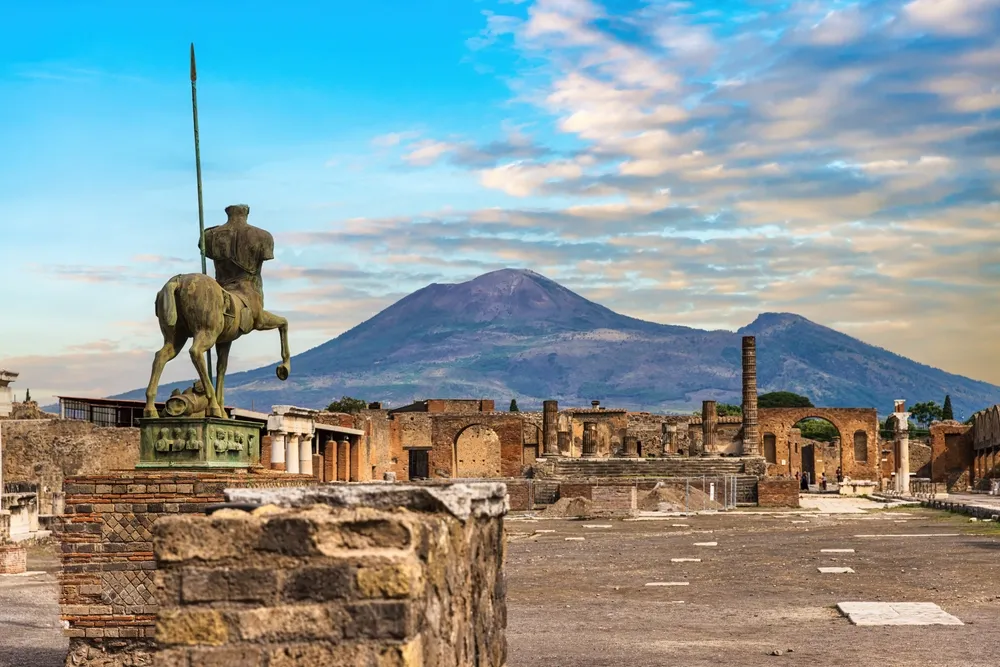
Most travellers planning a day trip from Rome to Pompeii don’t think to add the Reggia di Caserta to their itinerary. And that, honestly, is one of the great missed opportunities in Italian tourism. Here you have two UNESCO World Heritage Sites within striking distance of each other — an ancient Roman city frozen by a volcanic eruption in 79 AD, and an 18th-century Baroque palace so vast and opulent that it gave Versailles genuine competition — and they can be visited in a single, extraordinarily rewarding day.
After more than ten years of researching Italian travel, I’d argue that this particular combination is one of the most underrated day trips available from Rome. Here’s everything you need to know to plan it well.
Why This Combination Works Brilliantly
Two UNESCO World Heritage Sites, Two Different Eras
Pompeii and the Reggia di Caserta represent the full sweep of Italian cultural history — from the height of the Roman Empire to the peak of European Baroque architecture. Pompeii takes you to the ancient world: cobblestone streets, thermopoliums (the Roman equivalent of fast-food counters), frescoed private homes, and the haunting plaster casts that preserve the final moments of people who lived nearly two thousand years ago.
The Reggia di Caserta then transports you forward nearly eighteen centuries. Designed by architect Luigi Vanvitelli for Bourbon King Charles VII of Naples in 1752, it is the largest royal palace in Europe by volume, with approximately 1,200 rooms spread across five floors. The Royal Apartments are decorated with original Bourbon-period furnishings, frescoes, and gilded stuccoes. The Palatine Chapel, the Throne Room, and the Grand Staircase of Honour are individually extraordinary. The park behind the palace stretches for three kilometres, with a series of classical fountains — including the famous Fountain of Diana and Actaeon — fed by the 18th-century Carolino Aqueduct, which itself is an engineering marvel spanning 40 kilometres.
The Geographic Logic of the Route
Caserta sits just 30 kilometres north of Naples and can be reached from Rome by train in approximately 1 hour 15 minutes to 2.5 hours depending on the service. Pompeii is 30 kilometres south of Naples. Most organised Pompeii and Caserta day trips from Rome route through Naples, visiting Pompeii in the morning and Caserta in the afternoon (or vice versa), with private transport connecting the sites.
The Caserta train station is a 5-minute walk from the palace entrance, making it highly accessible. For independent travellers combining both sites, the sequencing typically works best with an early arrival at Pompeii (before 10:00 AM), 3 hours at the archaeological site, lunch in or near Caserta, then 2–3 hours at the Reggia before the return train to Rome.
The Reggia’s Hollywood Credentials — A Fun Footnote
If you’ve seen Star Wars: Episode I — The Phantom Menace, you’ve already been inside the Reggia di Caserta without knowing it. The palace served as Queen Amidala’s royal residence in the 1999 film. More recently, the Reggia appeared in Conclave (2024), the acclaimed film directed by Edward Berger. The Grand Staircase of Honour also appeared as a Vatican staircase in Angels and Demons. These cameos add a fun contemporary dimension to a place whose history spans centuries.
What to Expect at Each Site
Planning realistic expectations for both stops is essential for making this day work well.
Four Planning Tips for the Pompeii and Caserta Day Trip
Book Pompeii tickets and Reggia di Caserta tickets separately in advance — both are nominative and benefit significantly from online booking to skip ticket queues. Pompeii’s 20,000 daily visitor cap makes advance booking especially important in peak season.
Start with Pompeii, not Caserta. Pompeii requires energy and focus, and it’s better to tackle the archaeological site while you’re fresh. The Reggia’s grandeur is more forgiving of tired legs — you can sit in the Royal Park and appreciate it from a bench if needed.
Allow at least 2 hours at the Reggia — 1.5 hours minimum for the Royal Apartments, plus time in the garden. The park alone covers 120 hectares; you can rent a bike for the full garden circuit if you want to see the famous waterfall at the far end.
For the journey between Pompeii and Caserta, private transport is the most efficient option. The train route requires a change in Naples which adds time; a private driver or tour vehicle makes the transition seamless.
A Detailed Look at the Reggia di Caserta
The Royal Apartments
The interior tour of the Reggia begins with the Grand Staircase of Honour — a theatrical, double-ramped marble staircase that sets the tone for everything that follows. From there, you’ll move through the anterooms, the Palatine Chapel (modelled on Versailles’ chapel but arguably more intimate), and the state rooms, which include the Hall of Alexander, the Hall of Mars, and the Throne Room.
The rooms are furnished with original Bourbon-period pieces — gilded furniture, Flemish tapestries, neoclassical sculptures, and porcelain collections from the nearby Real Fabbrica di Capodimonte. The overall effect is of a palace that was genuinely lived in and governed from, rather than merely displayed, which gives it a warmth that some of Europe’s grander royal residences lack. In 2023 alone, the Reggia drew close to a million visitors — but because of its sheer size, it rarely feels crowded inside.
The Royal Park and Gardens
Behind the palace, the Royal Park stretches three kilometres toward a distant waterfall fed by the Carolino Aqueduct. The formal Italian garden near the palace features geometric lawns, fountains, and classical sculptures. As you walk (or cycle) toward the cascade, the fountains grow progressively more dramatic: the Fountain of the Three Dolphins, the Fountain of Aeolus, and finally the spectacular Fountain of Diana and Actaeon, where white marble figures emerge from the water at the base of the cascade.
The English Garden, tucked to one side of the main axis, was designed for Queen Maria Carolina (wife of Ferdinand IV) in the late 18th century. It’s a romantic, informal space with rare botanical specimens, a bathing pool, and a small neoclassical pavilion — a complete contrast to the formal grandeur of the main garden and a lovely spot to pause before the return journey.
How to Combine This Day Trip with a Rome to Pompeii Guided Tour
The most elegant way to do this combination is through a private Pompeii and Caserta palace tour from Rome — a full-day private vehicle itinerary that handles all transport logistics, includes skip-the-line entry to both sites, and provides expert local guides at each stop. The Pompeii guide (ideally an archaeologist) covers the ancient city in depth, while a separate guide at the Reggia provides context for the palace’s history, architecture, and Bourbon heritage.
This option costs more than independent travel, but the time savings and logistical smoothness it provides make the day genuinely manageable. Without it, the time spent navigating between Pompeii and Caserta by public transport (a train change in Naples, a 45-minute journey each way) can easily consume 2–3 hours of your day.
Conclusion
The Pompeii and Reggia di Caserta day trip from Rome offers something rare: genuine variety within a single, coherent itinerary. Ancient Rome meets Baroque Europe. Volcanic tragedy meets royal magnificence. And both sites are so extraordinary individually that visiting them back-to-back feels not overwhelming but exhilarating — each one reframing the other in your memory. This is the day trip for curious travellers who want to understand Italy in depth, and it’s one I recommend without hesitation.