All Blogs
Pompeii Hours, Entrances & Luggage Rules: The Full 2026 Guide
Popular Tours
Most Pompeii guides tell you what to see. Almost none of them tell you what time the gates actually open, which entrance to walk toward when you get off the train, or what happens if you show up with a rolling suitcase. Those details sound small until you're standing at Piazza Esedra at 8:50 a.m. wondering if you're in the right place, or realizing your carry-on bag isn't allowed past security.
This guide covers the logistics the official park website scatters across a dozen different pages: hours by season, which of the three entrances to use, how to get to Pompeii by train from Naples, what to do with your luggage, and the rules that can catch first-time visitors off guard.
What time does Pompeii open?
Pompeii opens at 9:00 a.m. every day of the year, with two exceptions: December 25 and January 1. There's no early-bird entrance and no way to get in before opening, even with a pre-booked ticket, so the "arrive before the gates open" advice you'll read elsewhere is genuinely worth following if you want to beat the tour groups and the midday heat.
Closing time depends on the season, and this is where a lot of visitors get tripped up, because "closing time" and "last entry" are not the same thing.
What time does Pompeii close, and when is the last entry?
Pompeii runs on two seasonal schedules:
From October 16 to March 15 (winter hours):
Gates open at 9:00 a.m.
Last entry at 3:30 p.m.
Site closes at 5:00 p.m.
From March 16 to October 15 (summer hours):
Gates open at 9:00 a.m.
Last entry at 5:30 p.m.
Site closes at 7:00 p.m.
The gap between last entry and closing exists so you have time to actually walk the ruins rather than being rushed out the moment you get in. In winter that's about an hour and a half; in summer it stretches to roughly ninety minutes as well. Either way, plan to arrive well before the last-entry cutoff. Pompeii is large. Even a focused visit takes two to three hours, and a thorough one can easily fill a full day, so walking in an hour before last entry means seeing only a fraction of the site.
Note that these hours apply to the main archaeological area of Pompeii. The Suburban Villas route (Villa of the Mysteries and Villa of Diomede), which is included with the Pompeii Plus ticket or can be added to the standard ticket, has its own last-entrance time at the Herculaneum Gate: 3:30 p.m. in winter and 5:30 p.m. in summer. If seeing the Villa of the Mysteries is a priority, don't leave it for the very end of your visit.
Is Pompeii open on holidays?
Pompeii is open 365 days a year with the exception of December 25 and January 1. It stays open on Easter, Ferragosto (August 15), and every other Italian public holiday, so you don't need to plan around a closure unless your visit falls on Christmas or New Year's Day. Check the park's service announcements page before you travel, though, since the Archaeological Park occasionally posts short-notice closures for specific buildings or, rarely, weather-related site closures.
Is Pompeii free on the first Sunday of the month?
Yes. Like most Italian state museums and archaeological sites, Pompeii offers free admission on the first Sunday of every month as part of the national "Domenica al Museo" initiative. This is popular, so expect longer lines and a busier site than usual. If your main goal is a calmer visit rather than saving on the ticket price, pick a different day.
Which Pompeii entrance should you use?
This is the question that trips up more visitors than any other, because Pompeii has three public entrances and they're not interchangeable depending on where you're arriving from and what you want to see first.
Porta Marina is the main entrance and the one most visitors use. It sits close to the Pompei Scavi–Villa dei Misteri train station, so if you're arriving by the Circumvesuviana line from Naples or Sorrento, this is almost certainly your entrance. It's also the entrance that puts you closest to the Forum, so if you want to see the city's civic heart first, Porta Marina is the right choice.
Piazza Esedra, right next to Porta Marina, is a second access point with a self-service ticket office, useful if the Porta Marina line is backed up.
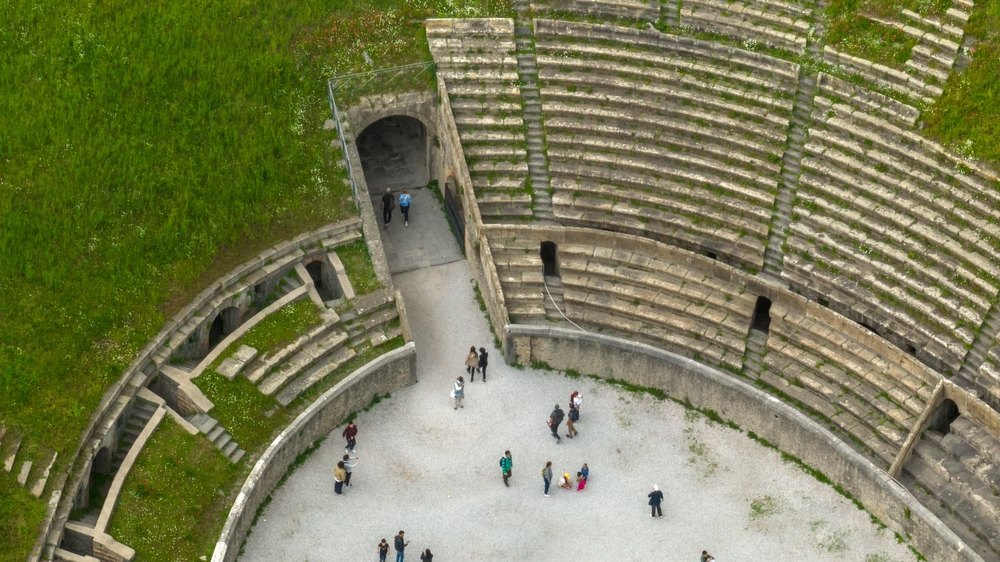
Piazza Anfiteatro sits on the opposite side of the site, near the amphitheater, and is the entrance most convenient if you're coming from the Circumvesuviana Napoli–Poggiomarino line (Pompei Santuario stop) or want to start your visit at the amphitheater and the Garden of the Fugitives rather than the Forum.
If you're not sure which to pick, default to Porta Marina. It's the busiest for a reason: it's the closest to the train, the closest to the Forum, and the one most tour groups and guides use as a meeting point.
Can you enter and exit and come back in later?
No. Standard Pompeii tickets are valid for a single entry. Once you exit, your ticket is used, even if you leave in the middle of the day intending to come back after lunch. If you want to step out to eat, do it before you enter, or plan to bring food and water with you and treat the visit as one continuous block. This single-entry rule is stricter than it used to be and now ties into the personalized ticket system described below, so don't count on any flexibility here.
Do you need ID to enter Pompeii?
Yes, and this catches a surprising number of visitors off guard. Since November 2025, Pompeii tickets have been personalized: each ticket carries the name of the ticket holder along with the assigned date and time slot. Park staff can request an identification document at any point to confirm that the name on the ticket matches the person using it. If the names don't match, you'll be refused entry with no refund.
In practice, this means you should buy tickets under the real names of everyone in your group, book them for the specific date and time slot you intend to visit, and bring a passport or ID card with you on visit day. This isn't optional paperwork. It's enforced with random checks throughout the day.
How many people are allowed into Pompeii per day?
There's a daily cap of 20,000 visitors, split into time-slotted windows so the site never gets overwhelmed all at once. From March 16 to October 14, the morning window (9:00 a.m. to 1:00 p.m.) allows up to 15,000 admissions, and the afternoon window (1:00 p.m. to 5:30 p.m.) allows up to 5,000. On a busy summer day, the morning slots can genuinely sell out, especially for anyone hoping to walk in without pre-booking. If you're visiting in peak season, June through September, or during a major holiday week, book your entry time online in advance rather than assuming you can buy a ticket at the gate.
Can you bring a backpack or suitcase into Pompeii?
Only a small one. The Archaeological Park limits bags to a maximum size of 30 x 30 x 15 centimeters, which is roughly the footprint of a small daypack or a large purse, not a full-size backpack or any kind of rolling luggage. Suitcases, large backpacks, and other bulky items aren't allowed inside and have to be left at the designated left-luggage area near the entrance.
This rule exists for site preservation and crowd-flow reasons as much as security, and it's enforced. If you're arriving straight from the airport with checked luggage in tow, or coming from a hotel checkout with a full bag, plan around it rather than finding out about it at the gate.
Where can you store luggage at Pompeii?
Each of the main entrances (Porta Marina, Piazza Anfiteatro) has a left-luggage service where oversized bags can be checked before you go through security. It's typically free or low-cost and is the standard solution for anyone doing a day trip with luggage, for example train travelers connecting straight from Naples or Rome without a hotel stop first. If you're touring Pompeii on the way to or from a flight, budget a few extra minutes at the entrance to check your bag before heading in.
Smaller items are fine to carry: a water bottle, a compact camera, a phone, sunscreen, and a hat all fit within the size limit and are exactly what you'll want anyway, since much of the site has little shade.
Can you bring food and water into Pompeii?
Water, yes, and you should. Food is only allowed in specific designated eating areas within the park, not anywhere you happen to be standing. There are a small number of cafés and rest areas along the main routes. Given how much ground you'll cover and how limited shade is across most of the site, especially in summer, bring more water than you think you'll need. There is no reentry if you step out to buy more.
How do you get to Pompeii from Naples?
The easiest and cheapest way from central Naples is the Circumvesuviana commuter rail line, which runs from Napoli Porta Nolana or Napoli Garibaldi (beneath Naples Centrale train station) toward Sorrento. Get off at the Pompei Scavi–Villa dei Misteri stop, which puts you within a short walk of the Porta Marina entrance. The ride takes around 30 to 40 minutes depending on which train you catch, and it's a frequent, inexpensive commuter service rather than a tourist shuttle, so expect basic trains and standing room during rush hour.
There's a second Circumvesuviana line, Napoli–Poggiomarino, that stops at Pompei Santuario instead, closer to the Piazza Anfiteatro entrance. Use this one only if you specifically want to start near the amphitheater.
If you'd rather use the mainline national rail network, the Trenitalia Napoli–Salerno line also stops at Pompei station, and a combined train-and-shuttle service called Pompei Link connects that station to the Archaeological Park in about 15 minutes.
How do you get to Pompeii from Naples Airport?
There's no direct train from Naples Airport (Capodichino) to Pompeii, so the trip involves a connection. The most common route is a taxi or the Alibus airport shuttle into central Naples, followed by the Circumvesuviana train to Pompei Scavi–Villa dei Misteri. Door to door, budget around 90 minutes to two hours depending on traffic and connection times. If you're short on time or traveling with luggage that won't fit the on-site size limit, a private transfer or taxi straight from the airport to Pompeii is a more convenient, if pricier, alternative and skips the luggage problem discussed above entirely, since you won't be carrying bags through the site.
Can you get to Pompeii by bus?
Yes. SITA buses connect Pompeii with Naples and Salerno, and Busitalia Campania operates route 4 and an express coach, route 50, from Salerno via the motorway. These are useful mainly if you're already coming from Salerno or the Amalfi Coast rather than Naples, where the train is faster and simpler.
Should you drive to Pompeii?
You can, and there's a dedicated exit off the A3 Naples–Salerno motorway signed "Pompei Scavi." Paid parking is available near the site. Driving makes the most sense if you're combining Pompeii with other stops that aren't well served by train, or if you're renting a car for a broader Amalfi Coast or Sorrento Peninsula itinerary anyway. For a straightforward Naples-to-Pompeii day trip, though, the train is usually faster once you account for Naples traffic and parking.
What's the best time of day to arrive?
Arrive at or close to 9:00 a.m. Pompeii gets progressively busier through the late morning as day-trip groups from Naples, Rome, and cruise ships in Naples' port arrive together, and by midday the main routes near the Forum and the Amphitheater can feel crowded. An early arrival also means cooler temperatures, which matters because there's minimal shade across most of the ruins. If mornings aren't possible, the last two hours before closing tend to be quieter, though you'll be racing daylight and the last-entry cutoff.
Planning your visit
Once you know the hours, the right entrance, and what you can and can't bring, the rest of the visit comes down to how much time you have and what you want to prioritize. Check current tickets and tour options for guided visits that handle entry logistics for you, and see our plan your visit guide for suggested itineraries by time budget. If you're deciding whether Herculaneum belongs on the same day, our Pompeii vs Herculaneum guide breaks down the logistics of doing both.


