All Blogs
When Was Pompeii Discovered? Rediscovery, Digs & Today
Popular Tours
The Rediscovery of Pompeii
Here is a question that trips up most people the first time they think about it: if Pompeii was buried in the year 79, why did it take nearly 1,700 years for anyone to dig it back up?
The short answer is that people did stumble onto it, more than once, and either did not realize what they had found or decided to keep quiet about it. The longer answer is a good story, and it changes how you walk through the site. Once you know that about a third of the city is still under the ground, and that new rooms are being uncovered right now, the ruins stop feeling like a finished museum and start feeling like a work in progress. Which is exactly what they are.
Was Pompeii really lost?
Not entirely. For a few centuries after the eruption, people knew roughly where the city had been. Research published by the Archaeological Park in August 2025 showed that survivors and newcomers moved back into the ruins, living among the upper floors that still poked out of the ash and turning former ground floors into cellars. That improvised settlement seems to have carried on until around the fifth century, after which the site was finally abandoned and the memory faded.
By the Middle Ages the area was farmland. Locals called the low plateau "La Civita," a name that quietly preserved the idea that a city had once stood there, even if nobody remembered which one.
The accidental discovery of 1592
The first person on record to break into Pompeii was not an archaeologist. Domenico Fontana was a celebrated architect, the man who had re-erected the obelisk in front of St. Peter's, and he had just lost his job in Rome and moved to Naples. In 1592 he was cutting an underground channel to carry water from the Sarno River to the mills at Torre Annunziata. The route ran directly through the buried city.
His workers hit ancient walls covered in paintings and inscriptions. Fontana finished the channel anyway and, as far as anyone can tell, never announced the find. You can still see traces of his tunnel crossing the site today, and archaeologists have long debated whether he understood what he had cut through.
A century later the clues piled up. An inscription naming a town councillor of Pompeii surfaced in 1689, and in 1693 a scholar named Giuseppe Macrini dug trial trenches and wrote plainly that Pompeii lay under La Civita. Nobody with money acted on it.
1748: the digging begins (at the wrong town)
What finally got shovels in the ground was jealousy, more or less. Herculaneum, a few miles up the coast, had been discovered in 1709 and was being mined for statues and marble from 1738 on behalf of Charles of Bourbon, the king of Naples. The finds were spectacular, and the Spanish military engineer in charge, Roque Joaquín de Alcubierre, went looking for more.
In 1748 he started tunneling at La Civita. For years the team believed they were excavating Stabiae, a different Roman town. Early work was rough by modern standards: crews were after treasures for the royal collection, not information, and Karl Weber, the Swiss engineer who directed the work from 1750 to 1764, is generally credited as the first person to insist on careful plans and records.
The identity question was settled on August 20, 1763, when workers uncovered an inscription containing the words "Rei Publicae Pompeianorum," the commonwealth of the Pompeians. That is the date historians usually give for the confirmed rediscovery of Pompeii. The Temple of Isis followed in 1764, one of the first complete buildings to come out of the ground, and it caused a sensation across Europe.
From treasure hunt to science
Two later phases turned Pompeii into the site you visit now.
The French years
When French forces controlled Naples in the early 1800s, they put up to 700 workers on the site, joined the northern and southern excavations and exposed stretches of the Via dell'Abbondanza, the main street. For the first time visitors could grasp that this was an entire town.
Giuseppe Fiorelli and the plaster casts
Giuseppe Fiorelli took charge in 1863 and changed the rules. He divided the city into nine regions (regiones), numbered blocks (insulae) and individual doorways, a system archaeologists still use today. He published the first regular excavation reports. And he worked out that the strange hollows turning up in the hardened ash were the spaces left behind by decomposed bodies. By pouring plaster into those voids before digging them out, he produced the casts that are still Pompeii's most haunting objects. Twenty-two of them went on permanent display in the Palestra Grande in March 2026, the first time the park has told the story of the casts in a dedicated exhibition.
The twentieth century, including a war
Amedeo Maiuri ran the site for decades from the 1920s, dug beneath the AD 79 level for the first time to learn how old the town was, and exposed most of the area south of the Via dell'Abbondanza in the 1950s. Fewer visitors know that Pompeii was bombed: in August and September 1943, Allied aircraft dropped around 170 bombs on the excavations after false reports that German troops were hiding in the ruins. The Forum area, several houses and the Antiquarium museum were hit.
How much of Pompeii is still buried?
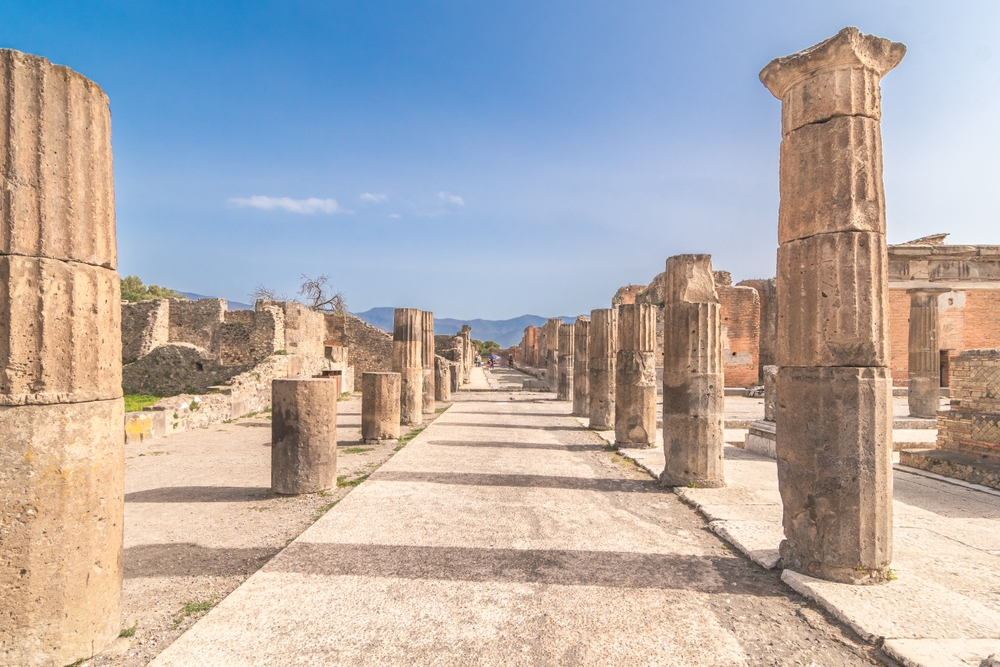
This is the part that surprises people. The ancient walls enclose about 66 hectares, roughly 163 acres. According to the Archaeological Park, around 15 hectares of city blocks and houses are still under the volcanic debris, close to a third of the ancient town.
And there is no plan to dig it all up. The current director, Gabriel Zuchtriegel, has described excavation as an unrepeatable act: whatever comes out of the ground is exposed to weather, tourists and time from that moment on. Since the EU-funded Great Pompeii Project began in 2012 with a budget of 105 million euros, the priority has been stabilizing what is already open. More than 2.5 kilometers of ancient walls were shored up, and new digging has mostly happened where it was needed anyway, along the unstable "edges" where excavated streets meet the buried hillside behind them.
That practical approach is precisely why the last few years have produced so many headlines.
What has been found recently
Regio V (2018 to 2020)
Work on the excavation edge in Region V uncovered the House of Orion, the House with the Garden and, in December 2020, a beautifully painted thermopolium, a Roman fast-food counter with food residue still in its jars. It went viral for a reason.
Regio IX, along Via di Nola (2023 onward)
In February 2023 the park opened a roughly 3,200 square meter dig, almost a full block, in the center of the site. Almost every season since has produced something remarkable:
A still-life fresco of a flatbread topped with fruit, which the press immediately nicknamed the "Pompeii pizza" (June 2023).
A cramped bakery where enslaved workers and donkeys ground grain behind barred windows, described by the park as a "bakery-prison" (December 2023).
A black-walled dining room decorated with scenes from the Trojan War, including Helen and Paris (April 2024).
A small shrine with rare deep-blue walls and figures of the four seasons (June 2024).
A huge frieze of a Dionysian procession running around three walls of a room in what is now called the House of Thiasus, the closest thing found to the famous Villa of the Mysteries fresco in over a century (February 2025).
In July 2026, a collapsed painted ceiling from the same block was pieced back together from about 1,000 fragments to reveal Dionysus and Ariadne.
The park has said the Regio IX dig is in its final phase and that the block will eventually be opened to all visitors once safety work is finished.
The Insula of the Chaste Lovers
Along the Via dell'Abbondanza, a whole block containing a bakery, stables and a wealthy home has been under excavation and restoration for years. In June 2024 archaeologists announced charcoal drawings of gladiators made by children on a courtyard wall, and in June 2026 they uncovered the skeleton of a donkey or mule in the bread-making room.
Can you watch the excavations?
Yes, and this is the single best reason to visit now rather than "someday."
The raised walkway at the Chaste Lovers. The block reopened to the public in 2024 with an elevated walkway that lets you look down into the working excavation and the restored bakery. Access is limited to a set number of people at a time, and the park's current listing gives it slightly shorter hours than the rest of the site (opening at 10:30 am), so do not leave it for the last hour.
Regio IX site visits. The park ran small guided visits to the Via di Nola dig, led by excavation staff, on set weekdays with advance booking. At the time of writing those visits are listed as temporarily suspended while the final safety works go on, so check the park's official announcements or ask your guide before you count on it.
Oplontis. If you buy the 3-day ticket, the Villa of Poppaea at nearby Oplontis began opening its new excavations to visitors on Thursday mornings in February 2026.
Any guided tour led by an archaeologist will also take you past the excavation fronts and explain what you are looking at. Our Pompeii tickets and tours page lists the archaeologist-led small-group options, including one that pairs Pompeii with Herculaneum if you want to compare how the two towns were buried and dug up. (Curious about that comparison before you book? Read Pompeii vs Herculaneum.)
What Pompeii looks like today, honestly
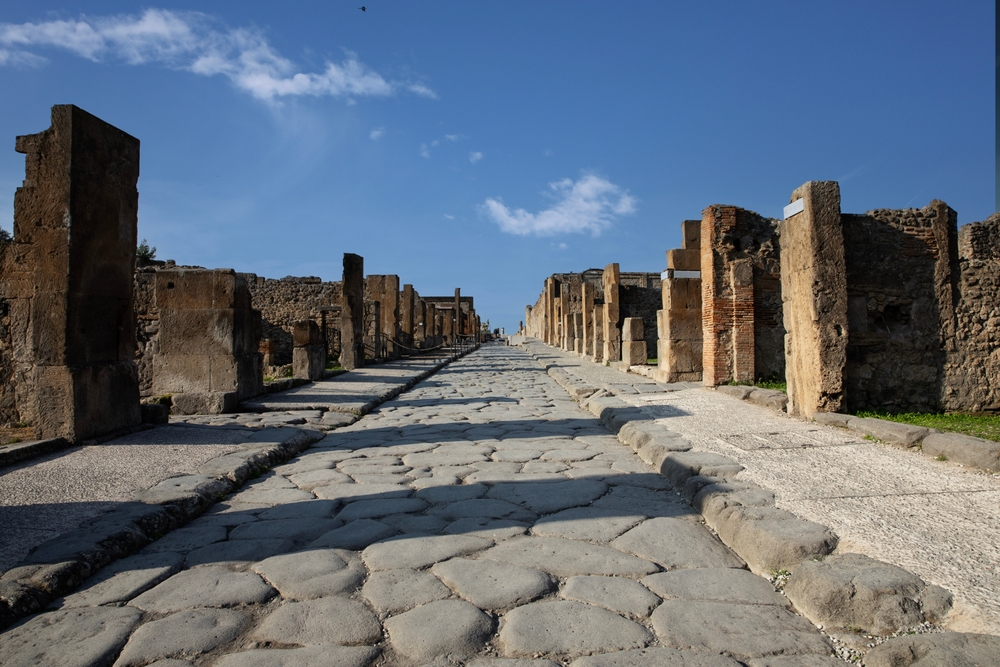
Walking in from Porta Marina, you climb a steep ramp and come out into the Forum with Vesuvius framed at the end of it. From there the city spreads out as a grid of stone-paved streets, most of them open to the sky, lined with roofless houses, shop counters and painted election slogans. A few things worth knowing before you go:
Not everything is open at once. The park rotates which houses are unlocked. In August 2026 it opened the House of Menander, the House of the Tragic Poet, the House of Pansa, the House of Octavius Quartio and the Fullonica of Stephanus, while closing a few others for conservation. The official "InfoDomus" list is updated regularly.
Ticket rules changed in 2026. Tickets are now personal, with your name on them, and the park caps entries at 20,000 a day, split into morning and afternoon time slots from mid-March to mid-October. The basic Pompeii Express ticket is 20 euros; Pompeii Plus, which adds the Villa of the Mysteries and the suburban villas, is 25 euros; a 3-day pass covering Oplontis, Stabiae and Boscoreale is 30 euros. Under-18s enter free. For the full rundown, see our plan your visit guide.
Hours. From March 16 to October 14 the site is open 9 am to 7 pm with last entry at 5:30 pm. In winter it closes at 5 pm with last entry at 3:30 pm.
It is big. Plan on three hours minimum. Our things to do in Pompeii page picks out the buildings worth prioritizing if you only have a morning.


